

XII MATHS SCI & COM VOL 1 BHANDAR
Author : Shri Sangati Publisher: Rajhauns Vitaran Pages: 524 ISBN: 81-7810-608-6 Book Cover: Softcover₹480
The Bhandar Series are a storehouse of questions and answers for std V-XII. They reduce the difficulty level, imbibe all concepts completely, enthuse to practise and help master the subject, leading towards perfection. Goa Board’s pattern is strictly followed. It’s a product of teachers’ experience and skill.
| Weight | 548 g |
|---|---|
| Language |
Related products
-

ENG-KON NEW GENERATION DICTIONARY
₹240Goans are exposed to English language in almost all the fields of activity wherein they come across quite a number of words whose meanings they may be seeking to know.
Rajhauns English-Konkani Dictionary has been designed in such a way that not only words but even expressions and usage are given in Konkani so that the exact nuance is properly understood.
This dictionary will help non-Konkani people to learn Konkani and also students, teachers, writers, users and general readers of English.
-
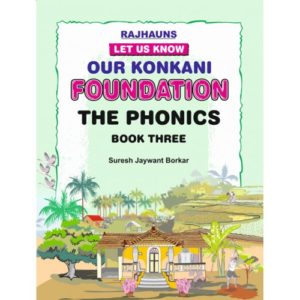
OUR KONKANI FOUNDATION The Phonics Book Three
₹50Konkani has, along with open and closed sounds,nasal accents. This book aims at teaching students,teachers and new learners the nasal sounds.
The nasal sounds in Konakni are very frequent and occur repeatedly. It is the speciality of the language. Nasal and non-nasal utterances totally change the meaning of the sentence. Illustrated examples are followed by exercises. An explanation is given at the end of every chapter. Step by step self-help book for all ages and stages.
-
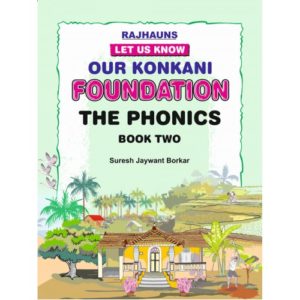
OUR KONKANI FOUNDATION The Phonics Book Two
₹50Konkani has open and closed sounds.This book aims at teaching students,teachers and new learners the closed sounds which are lesser than the open ones.
The closed sounds in Konkani, not so frequent as the open ones, are shown in this book. Illustrated examples are followed by exercises. An explanation is given at the end of every chapter. Step by step self-help book for all ages and stages.
-

GOA: A SOCIAL HISTORY 1510-1640
₹800The Social History of Goa is of great importance as it proves beneficial to research scholars and general readers and to understand the social interaction of the people of 16th century Goa. The book is written in an inimitable style and sustains the interest of the readers throughout.
-
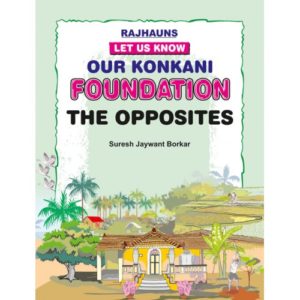
OUR KONKANI FOUNDATION The Opposites
₹50Like other languages, Konkani has a large number of opposites to adjectives, adverbs,verbs and pronouns.This book aims at training students,teachers, new learners the formation and use of the opposites.
Opposites of words are given here so that the student becomes familiar with the opposites of day to day adjectives, verbs and adverbs. Illustrated examples are followed by exercises. An explanation is given at the end of every chapter.
Step by step self-help book for all ages and stages.
-
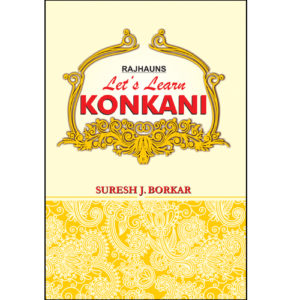
LET’S LEARN KONKANI
₹325An extract of Konkani grammar. The very essence of learning basic Konkani grammar in a nutshell with illustrations. Loads of exercises with blanks to be filled. Step by step self-help book for all ages and stages.A self-learner of Konkani. Useful for learning Konkani by way of systematic build up drills and exercises. The phonetic script (IPA) has been used in this book to facilitate pronunciation of Konkani.
Konkani-English and English-Konkani vocabularies have been given at the end of the book for the benefit of users. The time has come to restore the mother tongue of its rightful place.
-
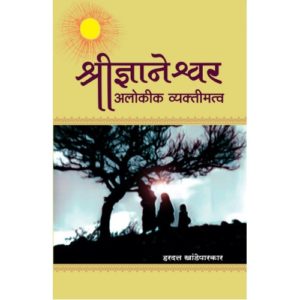
Shree Dnyaneshwar Alokik Vyaktimatva
₹100ज्ञानेश्वरी हातांत घेतली की ती बद्द काळजांतूच देंवता. ओवये फाटल्यान ओवी अर्थ-सौंदर्यान भरिल्ली जावन खेळत खेळत येता. दर्याचे भरतेच्या ल्हारां भशेन एकमेकींक खो दीत मोगान खेळत, फाटींफुडें जायत, स्वताच्या जाग्यार अखंड कल्लोळाचो खेळ खेळटा. श्रीज्ञानेश्वरांचे प्रतिभेची ही सागरक्रिडा अणभवत रावचें. ते सागरक्रिडेचो आनी त्या सागर संगिताचो केन्ना कंटाळो येना. प्रत्येक ल्हार वेगळें तरी पयलेंतलेंच दुसरें आनी दुसरेंतलेंच तिसरें आनी सगलें मेळून परत एकूच अथांग-अपार-सागरलीला रूप! म्हणून ल्हारां अनंत आसलीं तरी तांचें सागर संगीत, एकसंघ,गंभीर, अवकाश भरून उडोवपी, सगलें व्यापून खंयच नासपी; केवळ अपूर्व! ज्ञानेश्वरीचें स्वरूप हें अशें एक भव्य नाटयचित्र.
-
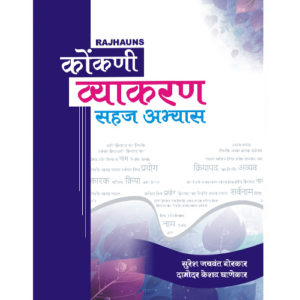
KONKANI VYAKARAN SAHAJ ABHYAAS
₹325An extract of Konkani grammar. The very essence of learning basic Konkani grammar in a nutshell with illustrations. Loads of exercises with blanks to be filled. Step by step self-help book for all ages and stages.