
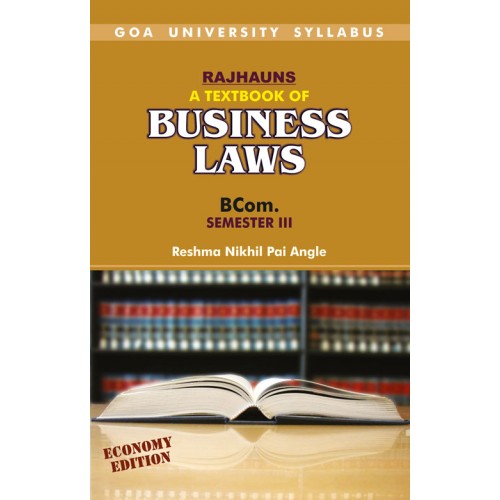
BUSINESS LAW B.Com Sem-III
Reshma Nikhil Pai Angle Publisher: Rajhauns Sankalpana Pvt. Ltd. Pages: 235 ISBN: 978-81-937215-6-8 Book Cover: Softcover₹200
| Weight | 246 g |
|---|---|
| Language |
Related products
-
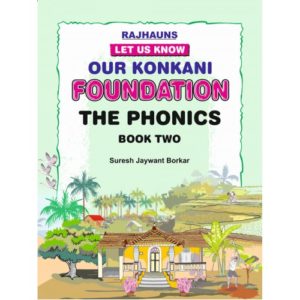
OUR KONKANI FOUNDATION The Phonics Book Two
₹50Konkani has open and closed sounds.This book aims at teaching students,teachers and new learners the closed sounds which are lesser than the open ones.
The closed sounds in Konkani, not so frequent as the open ones, are shown in this book. Illustrated examples are followed by exercises. An explanation is given at the end of every chapter. Step by step self-help book for all ages and stages.
-
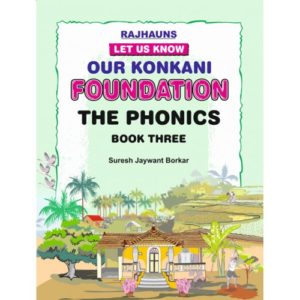
OUR KONKANI FOUNDATION The Phonics Book Three
₹50Konkani has, along with open and closed sounds,nasal accents. This book aims at teaching students,teachers and new learners the nasal sounds.
The nasal sounds in Konakni are very frequent and occur repeatedly. It is the speciality of the language. Nasal and non-nasal utterances totally change the meaning of the sentence. Illustrated examples are followed by exercises. An explanation is given at the end of every chapter. Step by step self-help book for all ages and stages.
-
-

GOA: A SOCIAL HISTORY 1510-1640
₹800The Social History of Goa is of great importance as it proves beneficial to research scholars and general readers and to understand the social interaction of the people of 16th century Goa. The book is written in an inimitable style and sustains the interest of the readers throughout.
-
KONKANI VYAKARAN SAHAJ ABHYAAS
₹325An extract of Konkani grammar. The very essence of learning basic Konkani grammar in a nutshell with illustrations. Loads of exercises with blanks to be filled. Step by step self-help book for all ages and stages.
-
BALANGAN / NURSERY RHYMES (K)
₹12A strong base for the kids to understand and learn their own language better. This is a Konkani rhymes book, full of short, sweet and melodious rhymes which are supported by attractive coloured illustrations.The child can remember and relate to whatever they learn. This book has also added information i.e. general knowledge for kids.
-

OUR KONKANI FOUNDATION The Plurals
₹50Plurals of nouns form in a number of ways. Plurals of masculine nouns form in two ways – either it is based on the ending or the open sound. Feminines form the plurals in two ways. Neutrals form their plurals by changing the ending accent.
Plurals of nouns change in many ways. The way the noun changes in the plural depends on its gender. While the number of the noun changes, the adjective as well as the verb also change their form. Step by step self-help book for all ages and stages.
-
NAVI VOLLOKH / ALPHABET (Konkani)
₹25A book to teach the Devanagari alphabet in an easy and flowing manner.Blank blocks to fill in letters and hollow letters to colour and paint is the highlight of this primer. Sets of syllables and the table book are an added attraction at the end.